The Mandate of the Dying King
TIME: LATE 1980s // LOCATION: APERTURE SUITE
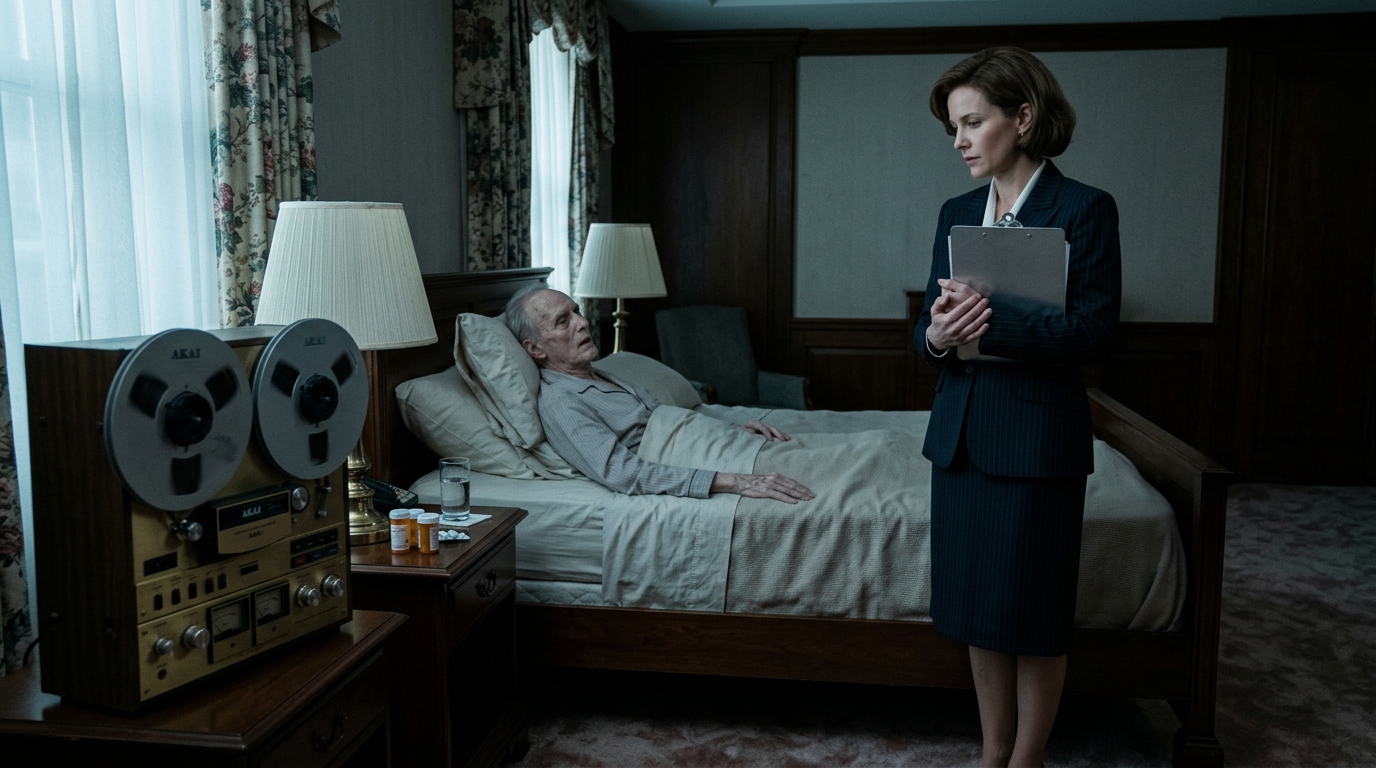
The air in the master suite of the Aperture Science Enrichment Center tasted of sterile dust and copper. In the late 1980s, the subterranean facility was already an empire built on the bones of a salt mine, cold and impossibly vast, but its heart was confined to a single, dimly lit room.
On the bed lay Cave Johnson.
The moon-rock poisoning had hollowed him out. His skin had the translucent, grayish quality of damp plaster, and his breaths came in rattling, fluid clicks. Yet his eyes - bloodshot and framed by deep, bruised hollows - still burned with the frantic, predatory focus of a man who believed he could bankrupt death itself.
"The bean counters... they want me to sign a transition of estate," Cave rasped. A violent fit of coughing shook his chest, the sound wet and terrible. He spat into a handkerchief, without bothering to look at the dark stain, and tossed it to the floor. "Idiots. All of them. We’re sitting on three thousand acres of salt mine, a quantum tunneling device that can tear a hole in the fabric of the universe, and they’re worried about who gets the parking spot."
Standing at the foot of the bed, a clipboard clutched tightly against her chest, was Caroline.
Her hair was pinned back in its customary, immaculate style, and her suit was crisp, but the strain showed in the tense line of her shoulders and the dark circles she couldn't entirely hide. She had been Cave's shadow, his organizer, his voice when his lungs failed him, and, in truth, the quiet engine that kept Aperture from collapsing under the weight of its founder's wild, unchecked genius.
"Mr. Johnson, the board is only trying to ensure stability," Caroline said softly, her voice steady despite the tremor in her hands. "We need to sign the payroll authorizations. The research teams in Sector Four are threatening to strike."
"Let 'em strike!" Cave snapped, waving a hand dismissively. "I’ll replace them with the bums from the park. They work harder anyway, and they don't ask for health insurance. No, Caroline. We don't sign anything. We build."
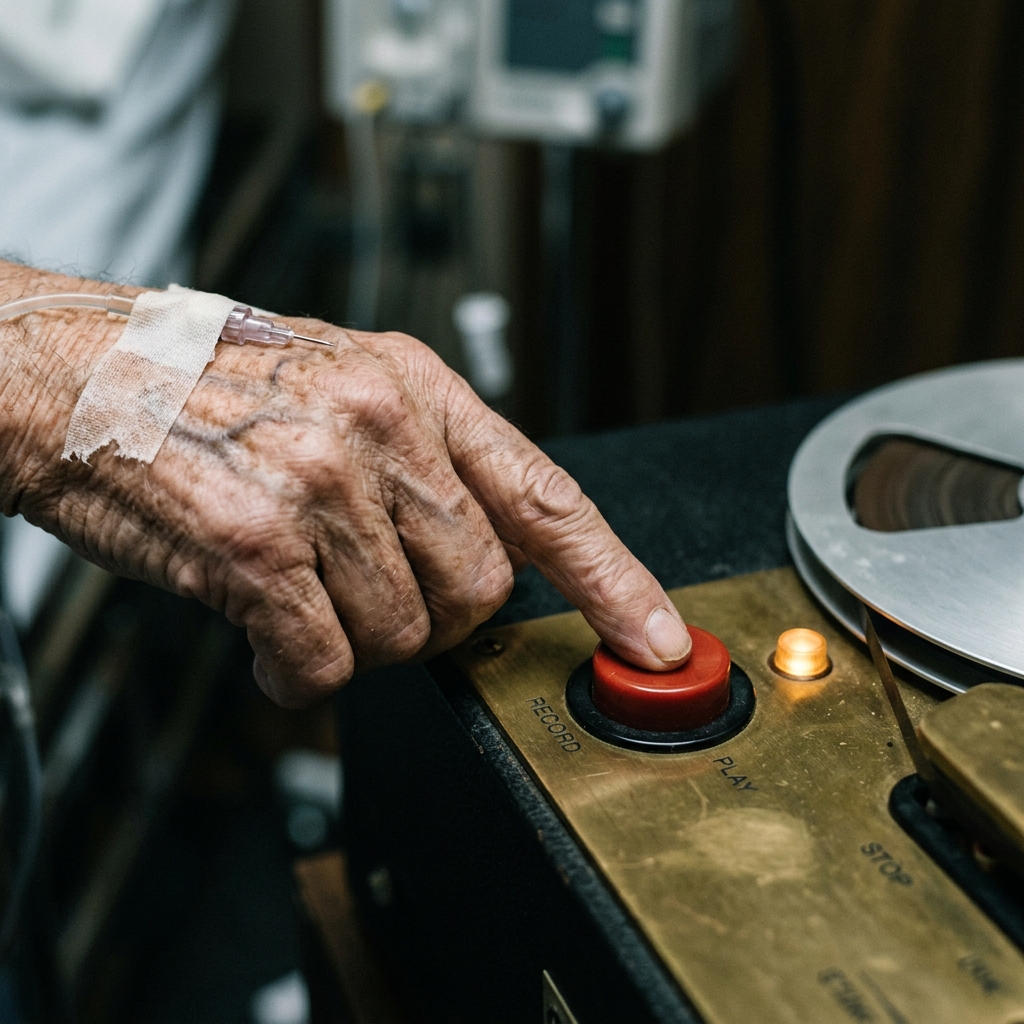
He reached out, his trembling fingers catching the brass casing of a desktop reel-to-reel tape recorder. He pressed the heavy red button. The plastic wheels began to spin with a quiet, rhythmic hum.
"Good. Recording is live," Cave muttered, leaning back into his pillows. His voice transitioned into the familiar, booming corporate baritone that thousands of Aperture employees had heard over the facility intercoms, though now it was underscored by a raspy wheeze.
"Aperture Science, Cave Johnson here. If you’re hearing this, it means I’ve finally kicked the bucket. The doctors say it was the moon dust, but I say it was the sheer, unadulterated lack of imagination in the medical profession. Regardless, we’ve got a backup plan. The boys down in the lab have been working on a brain-mapping system. Real cutting-edge stuff. The idea is to pour my consciousness into a mainframe, let me run this place forever as a computer. But science takes time, and time is the one resource I'm currently running out of."
He stopped to catch his breath, his chest heaving. Caroline stepped forward, pouring a glass of water, but he waved it away.
"So, here’s the directive. If I die before you people can pour me into a computer, I want Caroline to run this place. I’ve written it down, it’s in my will, it’s on this tape. She knows how I think. She knows what we’re trying to build here. And if the technology gets finished after I’m gone... you pour her into the machine. She’ll argue. She’ll say she can’t. She’s modest like that. But you make her. You put her in the system. Because without someone with a real, solid drive at the steering wheel, you people will just spend my money on carpets and desk lamps."
Cave hit the stop lever. The hum of the tape machine died, replaced by the mechanical wheeze of the room’s air filtration system.
Caroline stood motionless. The clipboard in her hands felt impossibly heavy. She looked at Cave, waiting for him to laugh, to cough, to say it was just another one of his dramatic scripts. But he only stared back, his expression flat, dead, and utterly serious.
"Mr. Johnson..." she whispered. "I don't... I am your assistant. I manage the schedules. I cannot be the facility."
"You won't just be the facility, Caroline," Cave whispered, his voice fading as his eyes drifted shut. "You'll be the future. Now... go tell the lab boys to get back to work."
---
Three weeks later, Cave Johnson was dead.
In the aftermath of his passing, the atmosphere of Aperture Science shifted from chaotic ambition to a quiet, clinical desperation. The scientists - men and women who had spent years operating under the constant threat of Cave's erratic firings - found themselves in possession of his final, recorded directive.
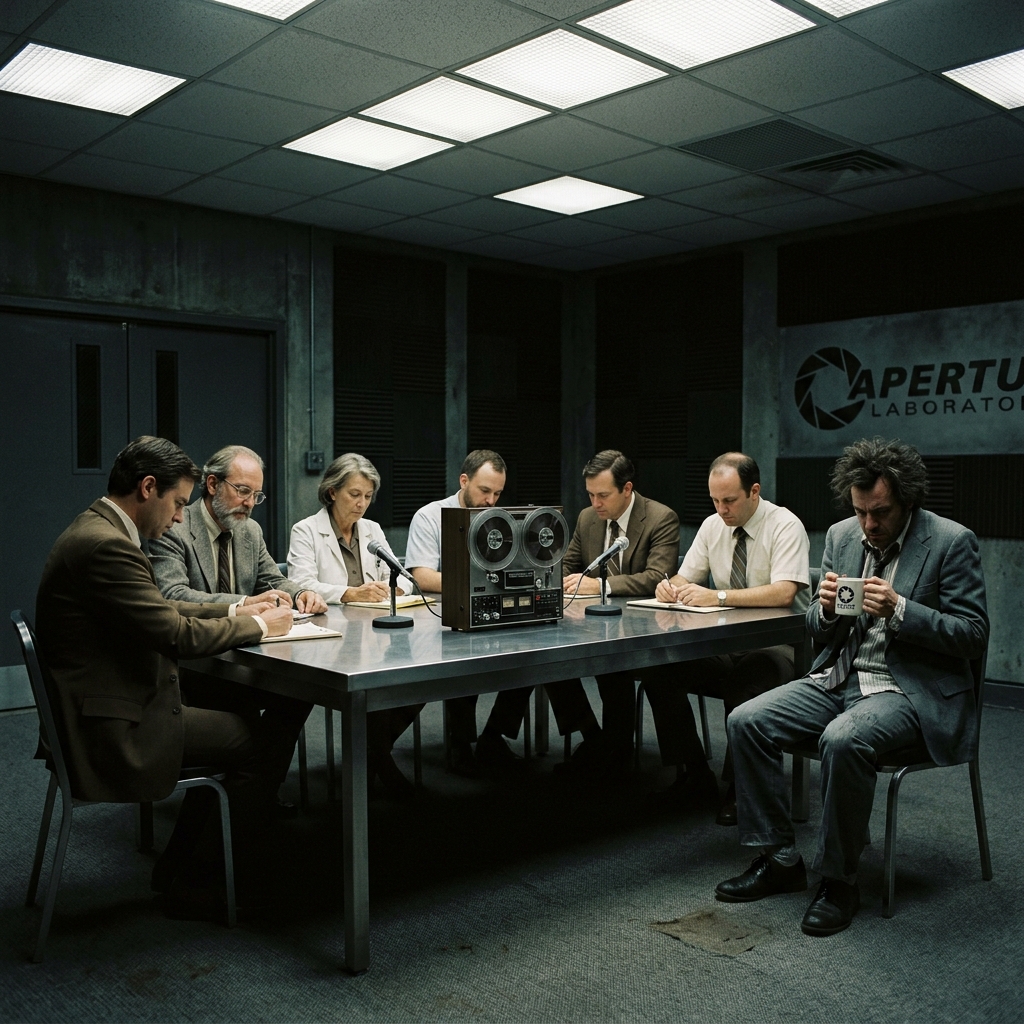
In the main conference room of the Sector C offices, Chief Engineer Aris Vance played the tape for the fifth time. The spinning reels hissed in the silence.
"She'll argue... but you make her."
Aris turned the machine off. Around the table, the senior researchers sat in silence.
Among them was Doug Rattmann, a senior systems programmer whose dark circles under his eyes seemed permanently etched into his pale face. He clutched his ceramic coffee cup with both hands as if searching for warmth in the sterile, fluorescent-lit room. His leg bounced with a restless, anxious energy.
"It's a direct order," Aris Vance said, leaning over the table, his eyes scanning the room for compliance. "It's in his estate papers. It's the law of the company."
"But it's Caroline," murmured Dr. Julie Ross, her eyes fixed on the empty table in front of her. "She's... she's the CEO now. She's running the daily operations. We can't just... strip-mine her brain."
Rattmann stared down at his ceramic cup, his knuckles white. The air felt heavy, suffocating. He wanted to speak, to scream that mapping a living consciousness into a mainframe was a moral and technological nightmare, but the words felt stuck in his throat. He just sat there, his leg bouncing in a manic, restless rhythm.
Vance turned his head, his expression hardening as he looked around the table, deliberately ignoring the silent, vibrating tension radiating from Rattmann. The other researchers shifted uncomfortably. They disliked Rattmann's constant, unspoken dissent, his refusal to align with the company's forward-looking optimism. Yet, nobody dared to challenge him directly. Rattmann was an indispensable asset; his intellectual grasp of the facility's low-level systems and his seniority meant he was irreplaceable. If anyone could prevent a system-wide collapse of the mainframe, it was him.
"We aren't strip-mining," Vance said, his voice dropping into a firm, patronizing tone. "We're fulfilling the founder's vision. And let's be honest with ourselves, everyone. The board is breathing down our necks. Black Mesa’s HEV suit project is already receiving massive government subsidies, and we're looking at a complete bankruptcy shutdown by next quarter if we don't produce a working, autonomous facility manager. Fulfilling Cave's directive isn't a choice. It's our only survival strategy. Mr. Johnson left us the blueprint. He left us the permission."
The scientists around the table nodded slowly, one by one, eager to let Vance’s words wash away their doubts. The tape recorder sat in the center of the table like a mechanical judge. It gave them permission. It dissolved their personal guilt. They weren't committing an atrocity; they were simply executing the will of the dying king. Only Rattmann remained silent, staring down at his coffee, his heart heavy with the certainty of a coming disaster.